


Church logo design needs 5 decisions: congregation identity, symbol meaning, name hierarchy, reproduction and stewardship. Begin with the community’s own brief rather than choosing a generic religious icon. A useful identity should remain recognisable on a building sign, a service sheet and a small digital profile without making claims the congregation has not approved.
Which church logo direction fits the congregation?
Identify who the logo represents. A local congregation, a wider ministry and a particular programme may need related but distinct identities. Confirm the official name, any approved short form and the body authorised to make the decision. Avoid allowing a temporary campaign title to become the permanent church identity simply because it fits a convenient template.
Collect the congregation’s account of its character and purpose. Ask which values should be evident, which symbols have recognised meaning and which associations should be avoided. The designer should not invent theological significance and then present it as the community’s tradition. Record interpretations in the congregation’s own approved language and distinguish a proposed metaphor from an established symbol.
Compare a wordmark-led direction where the name itself carries recognition. A carefully composed name can avoid an overcrowded collection of symbols and remain clear in practical use. Test the actual full name and any authorised short form. Do not assume that a long name should be reduced to initials if those initials would be unfamiliar to visitors.
Compare a symbol-and-name direction where the congregation has a meaningful approved emblem. The symbol should have a clear relationship to the identity rather than serve as a stock decoration. Ask the community to explain what it means before reading the designer’s rationale. If interpretations differ materially, revise the concept or clarify its intended role rather than treating ambiguity as depth.
Compare a place- or community-inspired direction when the connection is authentic and welcomed. A local visual reference may distinguish the identity, but it should not be used merely to make the logo appear culturally rooted. Obtain informed permission for sensitive motifs and avoid copying another organisation’s mark. Keep the source of inspiration and the design’s original construction in the project record.
How should symbols and reproduction be evaluated?
Establish the relationship between the name and symbol. A full lockup may suit signage while a compact approved variant may suit a profile image. Decide which elements must remain together and when a simplified version is permitted. This is a system decision, not an invitation for each volunteer to invent a new arrangement. Keep the approved variants in a small, legible usage sheet.
Test reproduction through actual intended uses. Inspect the mark on a service sheet, a digital profile and a proposed sign layout. Fine detail that looks attractive on a large canvas may disappear in a small reproduction. Adobe’s scaling guidance explains proportion and stroke-scaling controls, but technical scaling is only part of the task. The meaning and recognition still need visual review.
Preserve proportions and inspect stroke behaviour. Stretching a mark to fill a container changes its form, while scaling effects inconsistently can change the apparent weight. Prepare approved artwork variants rather than instructing volunteers to adjust it by eye. Record the output dimensions required by each destination instead of inventing universal minimum-size rules without testing the actual design.
Prepare an editable and rights-aware handoff. Adobe’s packaging documentation describes collecting the Illustrator document, linked assets and a report, with a warning about font permissions. Keep source files and final exports distinguishable. A church should know which files can be used in ordinary publishing and which require design software or separately licensed assets to edit.
Agree stewardship after approval. Name the person or team who stores the master, authorises changes and helps volunteers choose the correct variant. A shared folder full of conflicting files can gradually undermine an otherwise coherent identity. Retain an approved version reference and archive superseded options clearly. Do not present a concept selection as a complete identity handoff before reproduction and ownership have been checked.
Add a volunteer-use exercise to the identity handoff. Give a person unfamiliar with the design files the approved usage sheet and ask them to choose an asset for a service notice and a digital profile. Observe whether they can identify the correct version without stretching, recolouring or rebuilding it. If they cannot, improve file names and instructions before adding more variants. This tests stewardship rather than artistic preference. Keep any restricted motif or font use visible in the handoff so a well-intentioned volunteer does not create an unauthorised derivative while trying to produce ordinary church material.
Three original visual studies
These original SVG studies use fictional names and sample copy. They are illustrative comparisons, not actual clients, events, approved identities or production-ready artwork. The supplied screen renders have been inspected; physical reproduction and responsive application still need their own checks.
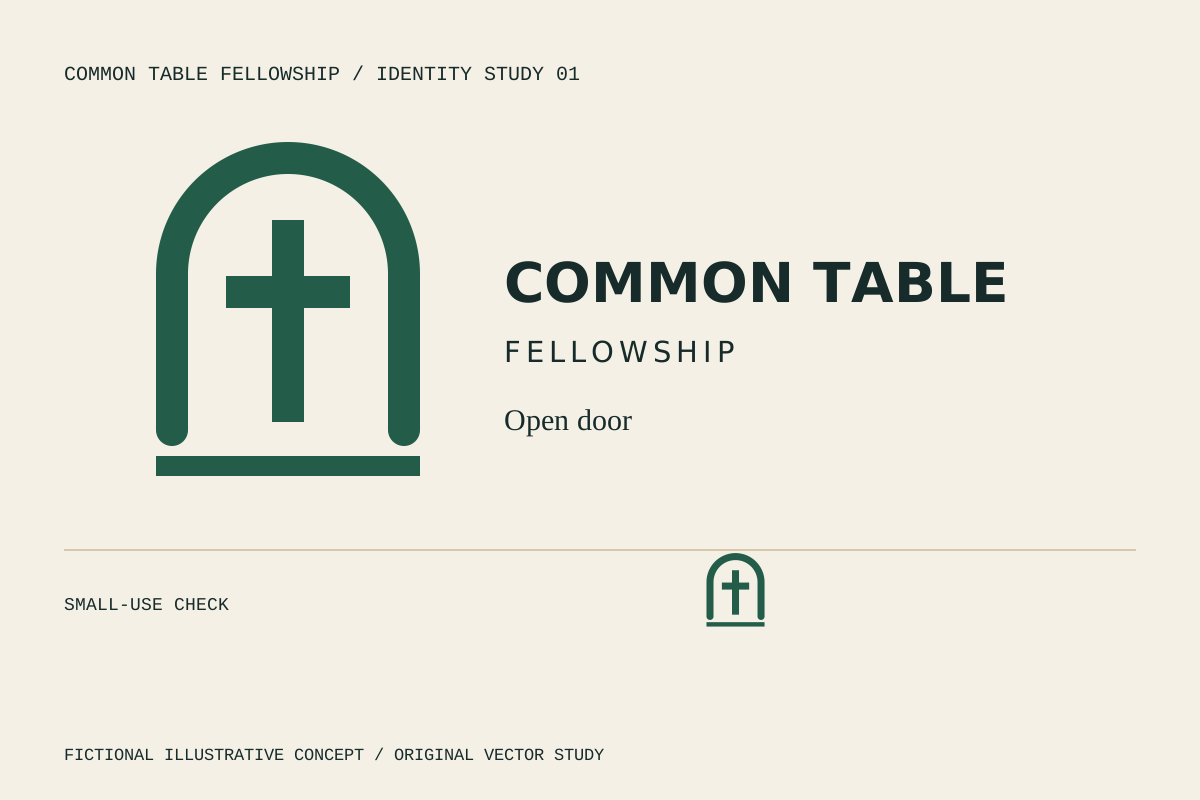
Open door combines an arch, cross and baseline with the fictional Common Table Fellowship name. The open arch remains visible in the small counterpart; theological interpretation still belongs to the congregation.
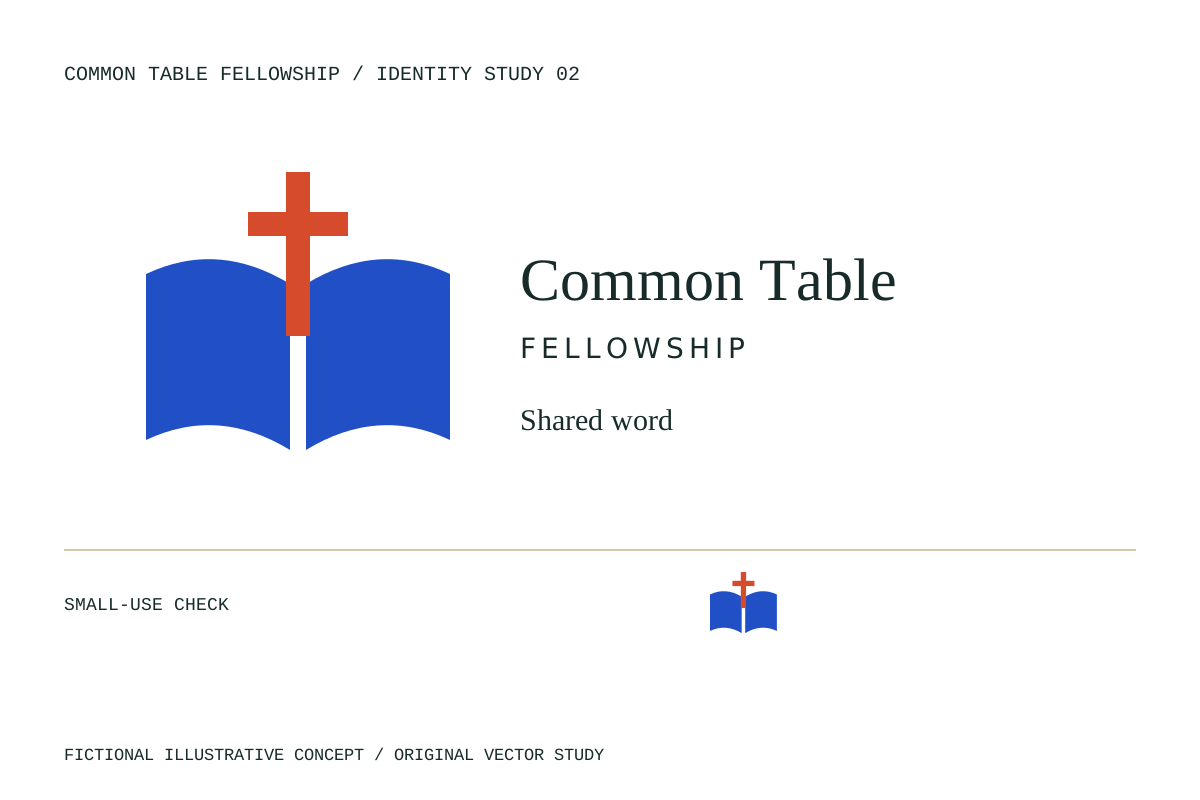
Shared word places an independent cross above two open-page shapes. The narrow centre gap needs checking in reproduction, and the study does not assert a denominational affiliation.
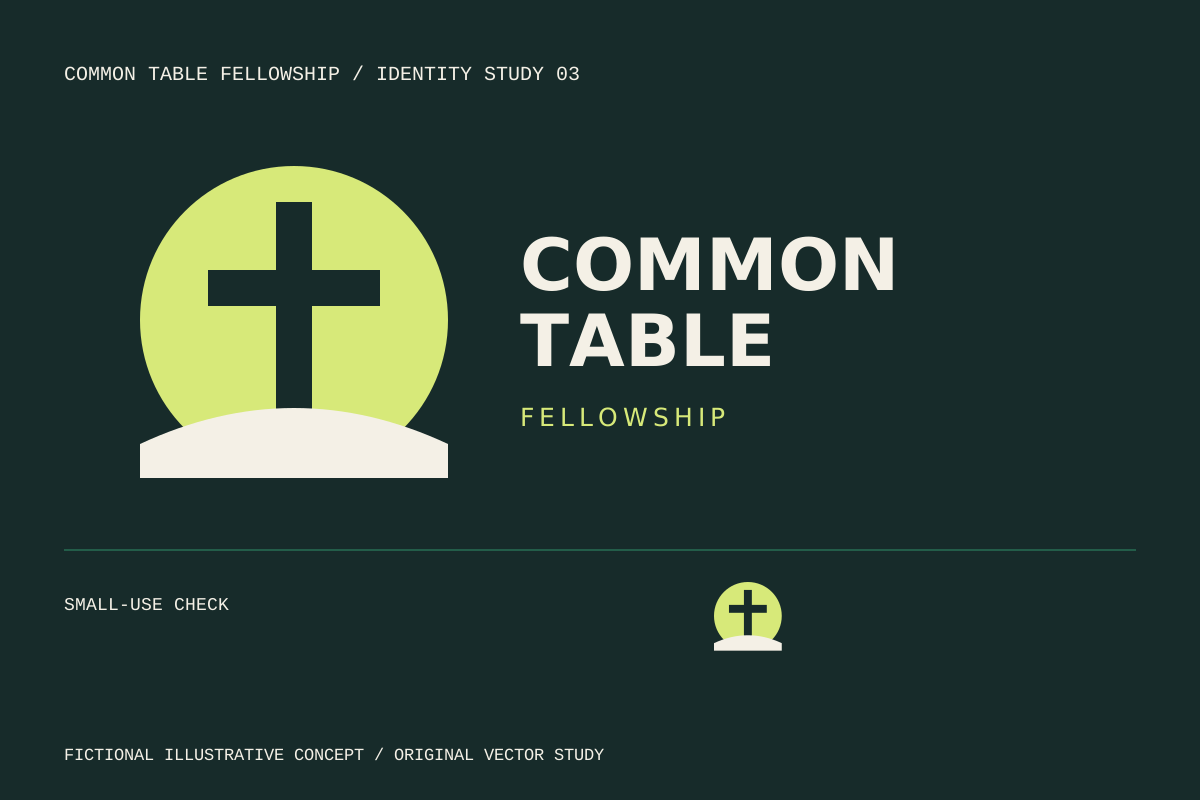
Gathered light places a cross against a circle above a broad table-like curve. The stacked wordmark changes the balance from the other lock-ups. Treat the symbolic reading as a discussion prompt, not an agreed theological statement.
Decision worksheet
Original contribution: a congregation symbol-and-reproduction card. Compare a wordmark, a symbol-and-name lockup and a community-inspired direction using the same approved name. Record what each concept communicates, who confirmed the interpretation and where it has been tested. Add separate rows for a service sheet, a small digital profile and a sign proposal. Keep concept approval, visual reproduction approval and asset handoff as distinct decisions. The card gives the congregation a way to discuss meaning and practical use without pretending that a stock symbol carries an agreed theological explanation.
| Checkpoint | Evidence to retain | Decision or corrective action |
|---|---|---|
| Congregation identity | Approved name, brief and decision body | Resolve competing identities |
| Symbol meaning | Community interpretation and permissions | Reject invented theological claims |
| Hierarchy | Wordmark, symbol and approved variants | Keep the name recognisable |
| Reproduction | Service sheet, profile and sign examples | Simplify only through approved variants |
| Stewardship | Master files, rights and change owner | Prevent conflicting volunteer edits |
See logo and brand design for identity context and web development for digital use. To discuss a church identity, get started with the approved name, existing assets and congregation brief.
By Spout Team. AI-assisted drafting by Codex using the linked primary sources.