


A farm logo should help customers recognise the producer without making unsupported claims about its products. Explore 4 decisions: the farm name, the activity the identity needs to cover, the packaging or signs on which it will appear and the artwork rights. A decorative crop symbol is not enough if the name becomes unreadable on a label.
Searches for farm logos often lead to templates and galleries. Use those to discuss visual directions, not as evidence that a design is exclusive or legally clear. An agriculture identity can refer to land, growth or a specific product, but it should remain honest if the business later adds another crop or changes its product range.
An original label-and-catalogue comparison
The fictional KILO FARM sheet compares a name-led producer mark with an abstract growth symbol. It shows each within a proposed label hierarchy and a small catalogue view. These are original illustrative studies, not commercial food labels, client work, approved names or evidence of product certification.
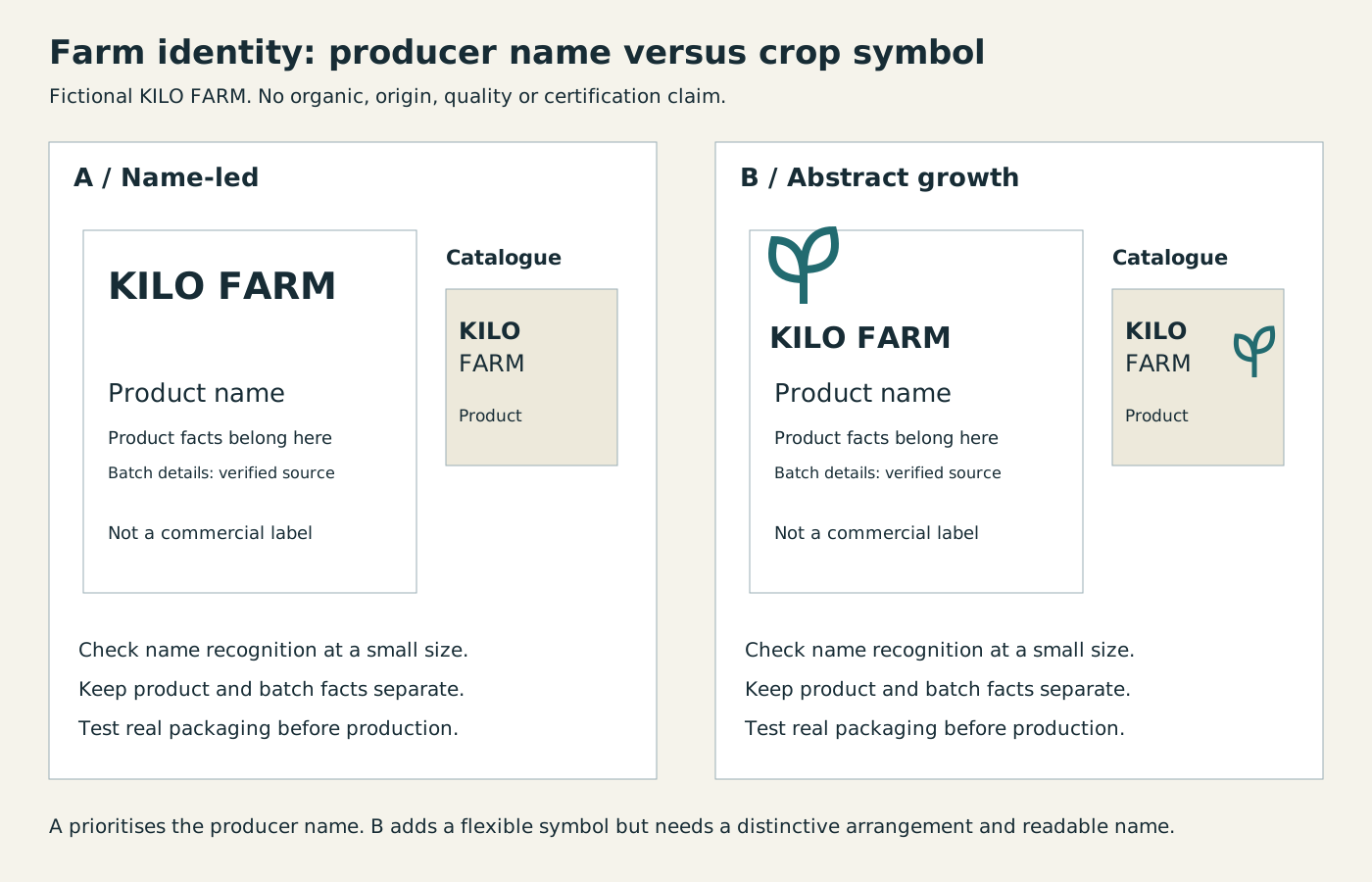
In the first direction, the producer name carries recognition without a crop-specific promise. In the second, the branching symbol adds a separate cue but occupies space the name or product information might need. The catalogue view makes that trade-off visible at a smaller scale. Neither arrangement inserts an organic badge, claimed origin or fabricated batch detail. Replace the explicitly illustrative product-information areas only with verified facts and applicable required label content. Inspect a real material and container proof before deciding whether either concept works for production.
Which farm logo concept fits the business?
Begin with the actual trading name and what customers need to identify. A producer selling several kinds of food may need a broader identity than a specialist product label. Keep the farm identity distinct from information specific to an individual product, batch or certification.
The following are original directions for a design brief, not finished artwork or available trademarks.
| Direction | Potential use | Question to resolve |
|---|---|---|
| Name-led wordmark | A clear producer identity across several products | Will the full name remain readable on small packaging? |
| Abstract growth symbol | A flexible visual identity without naming one crop | Is it distinctive enough to identify this producer? |
| Product-specific illustration | A focused line with a clear agricultural subject | Will it become misleading if the range changes? |
| Place-inspired mark | An identity tied to a genuine location or landscape | Is the geographical association accurate and appropriate? |
A leaf or sunrise can indicate a broad agricultural theme, but many unrelated businesses use similar imagery. Ask what makes the proposed arrangement recognisable as this farm. Do not add ornamental detail merely to make a familiar stock symbol appear original.
Be careful with symbols that imply a claim. A badge resembling certification, an organic label or a protected geographical indication should not be treated as harmless decoration. Identify which statements the business can actually support and obtain applicable advice where a regulated or protected claim is involved.
How should the logo relate to packaging?
Separate brand identification from product information. The logo can help a customer recognise the producer, while the label may also need product-specific facts and applicable mandatory information. This article does not establish Zambian food-labelling requirements. Confirm those for the actual product before approving a commercial label.
Design with the real packaging dimensions and material in view. A layout on a large white screen does not demonstrate what will happen on a small curved container, a textured bag or a label partly obscured by a seam. Ask the production provider for the relevant constraints and inspect a representative sample.
Use the actual product name and the longest likely variant. A system that works for a short sample can fail when the next legitimate product description arrives. Decide how the producer mark, product name and supporting information should relate so that every new label does not require an improvised hierarchy.
Adobe’s SVG guide explains how vector files differ from pixel-based images and can scale without losing resolution in the same way as raster enlargement. That supports retaining a suitable vector source for the identity. It does not eliminate the need to simplify fine details or verify the production method.
What should you check about originality and rights?
The USPTO’s strong-trademark guidance distinguishes distinctive marks from descriptive or generic ones in the United States trademark system. It is conceptual background, not a Zambian registration opinion. Do not transfer its registration rules to another jurisdiction or assume that a logo concept has been legally cleared.
Ask the designer to identify the source of each component. An original drawing, a licensed font and a stock illustration have different rights histories. Keep the relevant records with the approved assets. An image being described as free does not by itself establish exclusivity or permission for every branding use.
If a template is used as a starting point, establish the applicable licence and the limits of reuse. A design that other users can also adopt may be unsuitable where the main objective is a distinctive producer identity. Decide that openly before investing in printed packaging or signage.
Use this original farm identity proof record:
| Application | Test material | Decision to record |
|---|---|---|
| Product label | Real container and complete product information | Brand remains identifiable without crowding required content |
| Market display | Actual stall or display layout | Producer name and product information have clear roles |
| Delivery packaging | Intended material and printing method | Details survive the production process |
| Farm sign | Proposed placement and ordinary surrounding information | The identity is not mistaken for a certification notice |
| Digital catalogue | Phone-sized product image | Name remains recognisable after a practical crop |
| New product | A longer name from the planned range | Hierarchy works without redesigning the entire identity |
| Handoff | Source files, exports and rights records | Another authorised designer can use the system correctly |
The record avoids invented minimum sizes and print tolerances. Those depend on the actual artwork and production process. Ask the provider to specify and demonstrate what is required rather than copying a generic number from a template.
How can the identity remain useful as the farm changes?
Create a small set of usage rules rather than a single final image. Record approved arrangements, colour treatment, spacing and the relationship to product labels. Include examples using ordinary information, not only idealised mock-ups with very little text.
Keep product claims outside the permanent logo where appropriate. If a seasonal range, production method or certification changes, the business should be able to update the relevant information without making the identity itself false. This is a design-planning consideration, not a legal conclusion about any particular wording.
Retain the editable artwork and distinguish it from exports prepared for individual suppliers. A production adjustment should not silently become the new master for every future use. Record changes and have the accountable owner approve the final application before it goes to print.
See logo and brand design for the wider identity work. To explain a farm-logo requirement, get started with the correct name, product range, intended applications and any claims that need separate verification.
By Spout Team. AI-assisted drafting by Codex using the linked primary sources.